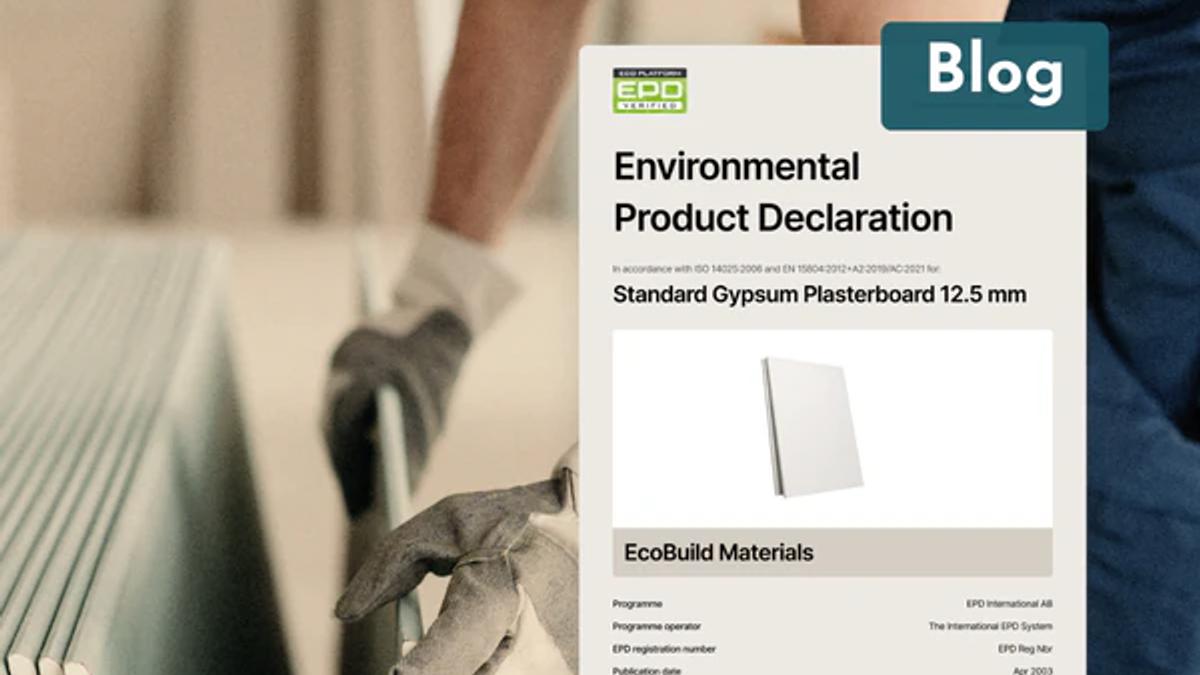
The construction industry is undergoing a major transformation. Sustainability is no longer a buzzword, it is becoming business-critical. At the center of this shift are Environmental Product Declarations (EPDs).
If you’re a building product manufacturer, 2026 is the year to act. Here’s why.
What is an EPD (Environmental Product Declaration)?
An Environmental Product Declaration (EPD) is a standardized, third-party verified document. It presents the environmental footprint of your product, based on a full Life Cycle Assessment (LCA).
It typically includes data such as:
Greenhouse gas emissions (CO₂e)
Resource and energy use
Waste generation and disposal impacts
In short, an EPD helps answer a question your customers care about: How climate-smart is your product?
➡ Read our Beginner’s Guide for Manufacturers on LCAs and EPDs
The market has shifted: from voluntary to mandatory
Ten years ago, EPDs were mostly used by innovators. Today, they are becoming a baseline requirement.
This shift is driven by three forces:
1) Tightening regulations
Across the EU and beyond, legal demands for sustainability data are accelerating. Key drivers include:
CSRD (Corporate Sustainability Reporting Directive): sustainability reporting now ranks alongside financial reporting
EU Taxonomy & Fit for 55: pushing the industry toward green building investments
Digital Product Passport & Smart CE-marking: environmental data will be built directly into product identification processes
Countries like Sweden, Norway, and Denmark have also introduced climate declarations for buildings. Product-level data is at the core of compliance.
2) Market demands and client expectations
EPDs are increasingly expected by:
Public procurement authorities
Large real estate developers
Architects, consultants, and sustainability managers
If you don’t have product-specific data, you may be excluded from tenders, shortlists, or preferred supplier programs. This can happen even if the product quality is high.
3) Competitive edge
EPDs are not just for compliance. They help you stand out.
Manufacturers that can back sustainability claims with real data can:
Build trust with climate-conscious buyers
Differentiate in crowded categories
Future-proof their brand and positioning
EPDs are more than paperwork. They’re a strategic asset.
An EPD is not just another document. It is a tool that can drive value across your business.
It can help you:
Win tenders and specifications by meeting sustainability criteria
Improve product performance using insights from LCAs
Support internal strategy with data-led improvement plans
Communicate your commitment to responsible production
In today’s landscape, sustainability without measurement is just storytelling.
EPDs turn that story into proof.
Without an EPD, you can’t answer the question clients will ask
Your clients, especially those working on certified, climate-smart, or public projects, will ask:
What’s the environmental impact of your product?
Without an EPD, your answer may not be taken seriously.
Imagine two identical-looking products. The one with the verified lower climate impact will win, even if it costs slightly more. That’s the power of transparency.
Start where it matters most
You don’t need to create EPDs for every product overnight. Start smart:
Focus on your best-selling products.
Use grouping strategies to reduce complexity and cost.
Build your portfolio incrementally over time.
Many manufacturers find that a smaller share of SKUs accounts for most revenue, and that’s often where the greatest impact lies.
➡ If you need a verified EPD for your products, start here: Create your EPD with Prodikt
From EPD to market activation with Prodikt
Creating an EPD is only part of the journey. What matters next is how you use it.
Prodikt’s positioning is clear: make environmental product data accessible, actionable, and comparable for the industry.
And there is a practical reason this matters. Even when EPDs are the accepted standard, the data often ends up locked in static PDFs, which makes it hard to use in digital workflows and business systems at scale.
Prodikt also describes its database as a central hub where product data (including technical specs, climate data, and compliance info) becomes accurate, structured, and easier to use across the value chain.
For manufacturers, Prodikt highlights sustainability support, including guidance on climate data and EPD creation.