
Get a verified Environmental Product Declaration (EPD) and turn it into structured climate data you can use across your portfolio and digital channels.
Create an Environmental Product Declaration (EPD) for your products, guided by a team specialized in Life Cycle Analysis (LCA) and EPD workflows. When your EPD is ready, we help you connect it to your products so the data becomes searchable, comparable, and usable in digital workflows, not locked in a PDF.
Prodikt makes product information shareable and usable across the construction value chain, covering technical specifications, climate-impact data, and compliance information.
For manufacturers, the value is clear: when your product is published, it becomes accessible to stakeholders using Prodikt for procurement and specification, and your data can be structured and maintained for ongoing use.
That’s exactly where EPDs come in.

An Environmental Product Declaration (EPD) is a standardized, independently verified document that reports a product’s environmental impacts based on Life Cycle Assessment (LCA).
For building products, an EPD typically includes metrics such as carbon footprint (Global Warming Potential / CO₂e) across defined life-cycle stages (e.g., manufacturing and transport), following recognized standards.
Because EPDs are standardized and third-party verified, they help building product manufacturers meet procurement and compliance requirements, support project documentation, and provide reliable environmental data for digital product databases and reporting.
Learn more:
➡ What Are LCAs and EPDs? A Beginner’s Guide for Building Product Manufacturers
EPDs are widely accepted for verified environmental performance, but they’re operationally intensive to produce and require ongoing maintenance.
Many EPD programs have a limited validity period (often around 5 years, depending on the program operator), meaning updates and reissuance are part of the job, not exceptions.
What manufacturers struggle with:
%20(1)%20(1)%20(1)%20(1)%20(1).png)
Whether you’re creating your first EPD or scaling across a portfolio, we support you with a workflow designed for outcomes: EPD-ready documentation, faster iteration, and structured data that stays useful after publication.
What’s included:
.png)
Solution by EandoX, a sister brand of Prodikt, an AI-powered cloud-based global data platform that transforms your fragmented environmental product data into a structured, owned data layer across your supply chain, ready for evolving market requirements.
Do building product manufacturers need an EPD to publish in the Prodikt database?
If you want your products to be climate-ready in Prodikt, you typically need verified environmental documentation, and an EPD (Environmental Product Declaration) is the most widely recognized format for that. EPDs make your environmental performance transparent, comparable, and easier to use in procurement and specification workflows.
What is an EPD (Environmental Product Declaration)?
An Environmental Product Declaration (EPD) is a standardized, third-party verified document that reports a product’s environmental impacts based on Life Cycle Assessment (LCA). For construction products, EPDs often include metrics such as carbon footprint (CO₂e/Global Warming Potential) across defined life-cycle stages.
How long does it take to create an EPD for a building and construction product?
EPD timelines depend on your product complexity, data readiness, and the verification route. In general, the process can range from weeks to a few months, especially if supplier data needs to be collected or structured across multiple product variants.
Our solution with EandoX makes this process faster, more intuitive and scalable.
Why are EPDs difficult for manufacturers?
EPDs require structured inputs (materials, energy, transport, suppliers) and a consistent model across product ranges. The biggest challenges for manufacturers are usually:
- Collecting supplier and internal data consistently.
- Managing variants and product families at scale.
- Keeping the underlying dataset aligned when inputs change, maintaining the EPD when it needs renewal or updates.
Do EPDs expire or need to be updated?
Yes. Many EPD programs have a limited validity period (often around 5 years, depending on the program operator). EPDs may also need updates when product composition, suppliers, energy mix, manufacturing, or transport assumptions change, so maintenance is a normal part of EPD management.
What’s the difference between EPD creation and EPD maintenance?
EPD creation is producing the first verified declaration for a product (or product family).
EPD maintenance keeps it accurate over time by updating datasets, managing versions, renewing the EPD when it reaches the end of its validity period, and ensuring the latest information is linked to your products and digital channels.
Can Prodikt help if we don’t have all the data yet?
Yes. Many manufacturers start without complete LCA-ready data. We support you with data readiness: what’s required, how to structure it, where to find it internally, and how to approach supplier inputs, so you can progress without stalling.
Can Prodikt create EPDs for an entire product portfolio rather than just one product?
Yes. Our approach is designed for building product manufacturers with portfolios. We scope product families, prioritize the highest-impact categories, and set up a repeatable workflow so EPD creation and updates scale across multiple products and variants.
How does EandoX help with EPD creation and maintenance?
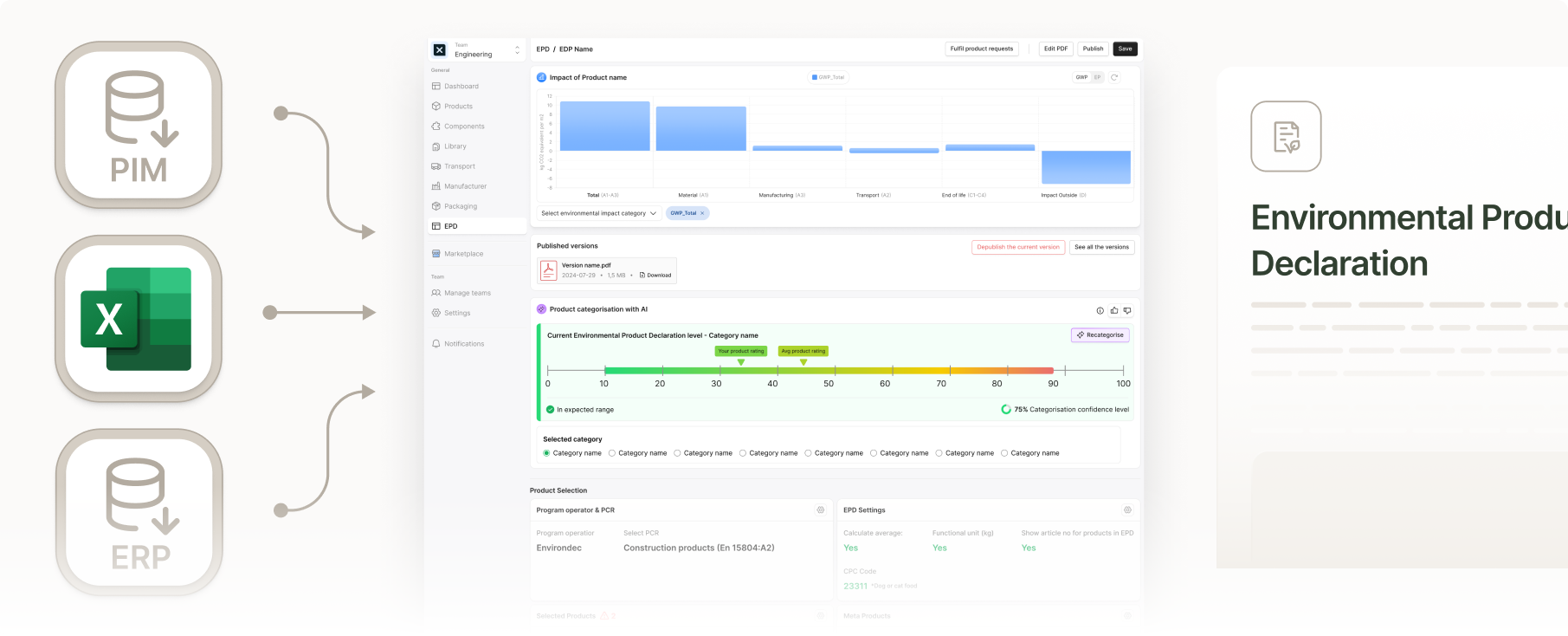
EandoX helps you move from “EPD as a PDF” to “EPD as a maintained dataset.” It centralizes sustainability inputs, structures them consistently across product families, supports version control, and makes it easier to generate and keep environmental documentation current, so your climate data stays usable over time.
What do you need from us to get started?
Typically, we start with:
- Product list and product family structure.
- Basic technical documentation.
- Bill of materials / material composition (where available).
- Manufacturing and energy data (where relevant).
- Packaging and transport assumptions.
If some of this is missing, we help you identify the gaps and prioritize what matters first
Do you only support EPDs or also other climate and compliance reporting?
EPDs are a common starting point, but manufacturers often need additional outputs such as product carbon footprint reporting, customer disclosures, or data structures that support evolving requirements. We can support broader reporting needs depending on your goals and markets.
What’s the first step to request EPD support?
Share your product category, portfolio size, and the markets you sell into. We’ll recommend the fastest path, whether that’s creating your first EPD, scaling across product families, or setting up a long-term maintenance approach.
Have further questions? Our team is here to answer them, book a call with our experts.
.png)