
Home / Prodikt / Database / Prodikt for Distributors / Investing in Data Flows
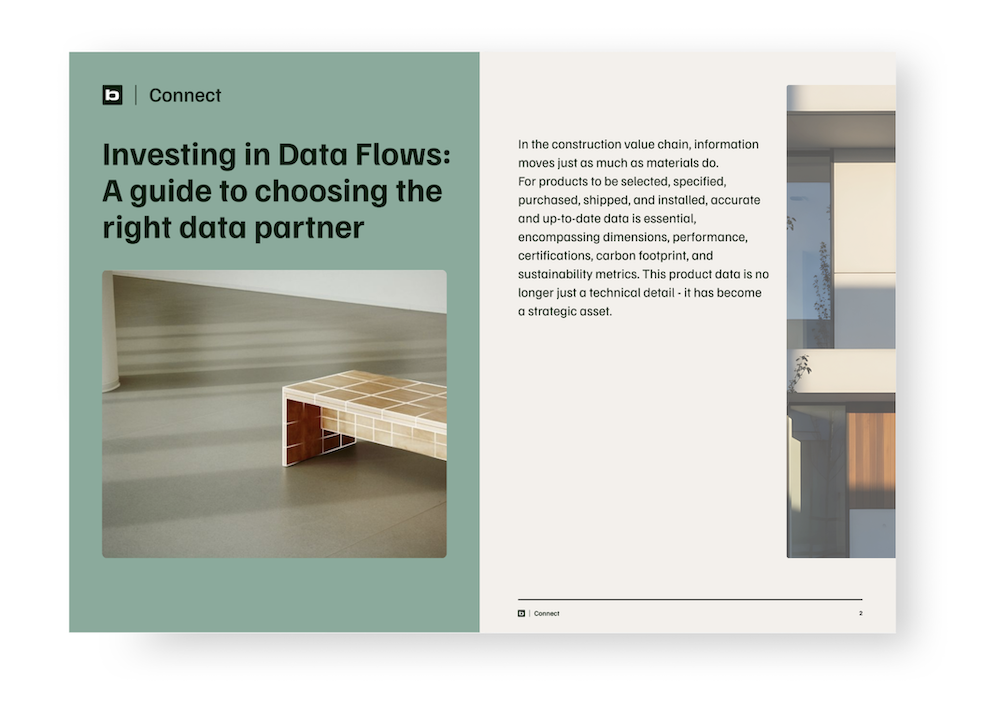
In the construction value chain, information needs to move as smoothly as materials. For products to be selected, specified, purchased, shipped, and installed, stakeholders rely on accurate, up-to-date product data from dimensions and performance to certifications, carbon footprint, and sustainability metrics. Product data is no longer just a technical detail: it’s a strategic asset.
Investing in structured product data helps organizations deliver:
Conclusion: Digitalization means moving away from static documents and ensuring product data is available in dynamic formats at the right moment, for the proper use cases.
Construction is becoming increasingly data-driven. Architects, engineers, contractors, distributors, and digital platforms need product information that’s structured and machine-readable.
When product data is digital, accurate, and current, teams across the value chain can:
Expectations around product information have expanded.
➡ Want a structured way to assess what “good” looks like? Read the complete buying guide.

Incorrect or incomplete product information can lead to delays, misunderstandings, and lost opportunities. Meanwhile, the growing demand for climate data and reporting makes manual processes harder to sustain.
To meet market and regulatory expectations, companies need product data management that is:
For the construction industry to become more efficient, sustainable, and transparent, stakeholders need to speak the same “data language.” That requires a digital hub that can connect systems, standardize formats, and ensure consistent data flow across sources.
➡ If you manage large product portfolios, standardization is the difference between constant manual work and scalable operations. Explore Prodikt for distributors.
A PDF may look digital, but it’s still a static file. PDFs can’t be integrated, analyzed, or updated automatically, often requiring manual handling that creates information gaps and blocks data exchange.
To build a truly data-driven supply chain, information must be:
Put simply: digitalization isn’t about files - it’s about flows.
➡ Not sure what to demand from a data partner beyond “we need it digital”? Read the complete buying guide.

To measure, compare, and reduce climate impact, stakeholders need access to accurate, well-structured climate-related product data. The challenge is that climate information is often only available in PDFs, with inconsistent formats and units and without proper version control.
Climate data typically describes a product’s climate impact as CO₂e (carbon dioxide equivalents) and can be based on:
Both types are needed to support credible reporting—especially when managing large product portfolios.
➡ Deep dive into this topic in our blog: Specific EPD data meets generic data: The key to traceability across your product portfolio
Even though Environmental Product Declarations (EPDs) are a recognized standard, they can be challenging to use in digital workflows because:
➡ If you need climate and product data to work in real workflows (not just PDFs), you’ll need the proper structure and governance. Explore Prodikt for distributors.
Go deeper on what to look for in a data partner, including the key questions to ask, evaluation criteria, and pitfalls to avoid.
Discover how to build a structured product database that supports automation, traceability, and climate reporting at scale.
.png)